


A month after the announcement allowing the private sector to import fuel, the numbers reveal an uncomfortable reality: the vast majority are excluded for structural reasons. This article analyzes real costs, viable business models, and the only path that could significantly increase access: collective purchasing.
—
What has happened in 30 days
Before delving into the numbers, it’s worth reviewing the key events of this first month, because the speed of developments has been as dizzying as it has been uneven.
It all began to take shape in January, when US President Donald Trump ordered the cessation of Venezuelan oil shipments to Cuba, and Mexico halted its own shipments under pressure. On January 29, an executive order threatened tariffs on any country that sold oil to the island. The energy blockade was tightening.
On February 7, the Cuban government responded with a historic announcement: private companies could import fuel directly, breaking the nearly 70-year-old state monopoly. In headlines, it was a revolution, although in practice, there were still no operational details. The news wasn’t entirely new to the most astute observers: in November 2025, Deputy Prime Minister Óscar Pérez-Oliva Fraga had first anticipated the possibility of changes in fuel imports. No one yet imagines what is coming. Mixed signals came from Washington. On February 10, OFAC issued a general license authorizing certain transactions involving Venezuelan oil, and on February 24, the Department of Commerce confirmed that exports to the Cuban private sector could qualify for the “Support for the Cuban People” exception.
Then, OFAC guidance established a licensing policy favorable to oil destined for the private sector, provided it did not benefit military or state entities. More recently, on March 4, a new provision prohibited depositing funds in Cuban banks, forcing payments to be channeled through third countries—a redundant provision of the long-standing sanctions against the island.
By the end of February, the first physical imports had arrived. Two or three micro, small, and medium-sized enterprises (MSMEs) were already using the fuel in their fleets, refueling at previously certified facilities. In just 30 days, we went from the historic announcement to the first imports, but also to the discovery that the path is much narrower than the headlines suggested. What follows in this article is precisely that: understanding, with numbers and sectoral analysis, why the vast majority of Cuban micro, small, and medium-sized enterprises (MSMEs) cannot navigate this path alone, and what alternatives exist.
A month later, the question circulating in conversations among business owners is not “how do I access direct imports,” but a much more uncomfortable one: does anyone know someone who has actually been able to do it?
The international press has covered the announcement with hopeful headlines. But no one has yet answered the questions that truly matter to a business owner who must make decisions: what does it really cost, who can do it, how many have access, and what alternatives exist for the majority?
The real cost: how much does it cost to import an ISO Tank?
To understand how much it really costs to import fuel, you have to forget about the international price and start adding things up. At AUGE, we’ve reconstructed the process step by step, with costs obtained from business owners who have tried it and from official sources.
The most suitable format is the ISO tank: a standard 20-foot tank container that allows for the transport of up to 25,000 liters of diesel via regular maritime shipping.
To establish a realistic starting point, we consulted several offers from supposed suppliers circulating on social media and in business groups. The prices vary significantly, from implausibly low figures to clearly speculative ones.
After analyzing different sources, we decided to work with the information published in OnCuba News, which places the price per liter at $1.58 USD. This yields a base cost of $39,500 USD per ISO tank.
From there, several components are added that determine the final price. This is a preliminary list of costs identified so far, although others may exist depending on the specific conditions of each transaction:
- Customs duties: Percentage of the merchandise value, according to the current Customs Tariff.
- State importer margin: Legally established charge for intermediary services.
- Port storage: Rates charged by the Mariel Container Terminal (TC Mariel).
- Land transport: Cost of a trailer from Mariel to the final destination.
- Fuel storage services: Payment for storing the merchandise in facilities with the appropriate conditions and required certifications.
The final result, considering all these factors, based on an analysis conducted by our team, shows a minimum cost per liter of approximately USD 2.00. This is 2.1 to 3.1 times cheaper than the black market, but well above the pure international price.
The interesting thing about this exercise isn’t so much the final figure, but understanding where the costs are concentrated and, therefore, where efforts should be focused to make importing more accessible. This analysis, the one that truly allows for informed decision-making, is precisely what we at AUGE offer to those who hire us to evaluate the viability of their operations.
Who will NOT be able to import individually
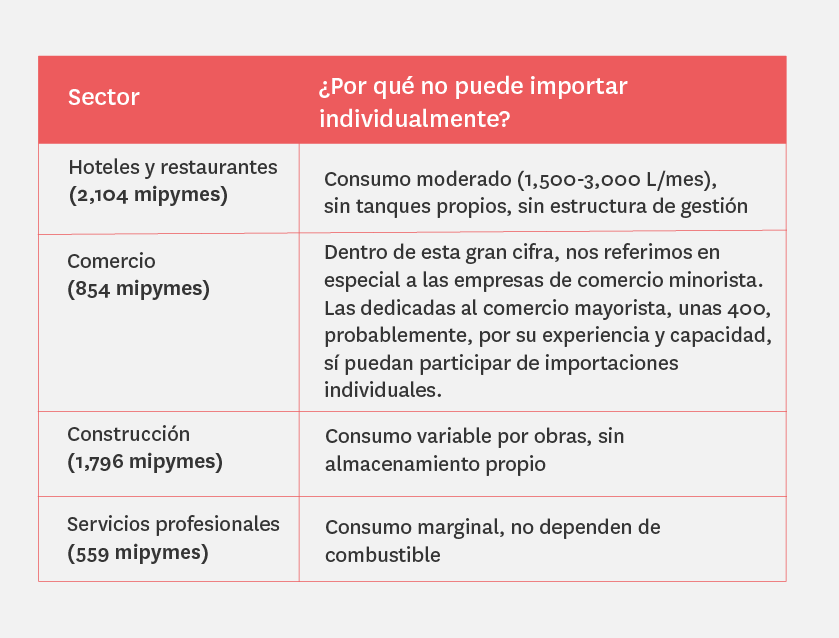
To understand who is in a position to import an ISO tank on their own, it’s sometimes more useful to start from the other side: analyzing the sectors that, by their very nature, are excluded.
In the first article of this series, we identified the sectors according to their level of energy dependence and their consumption profile. That same matrix now serves to map the exclusion.
The requirements that act as a filter
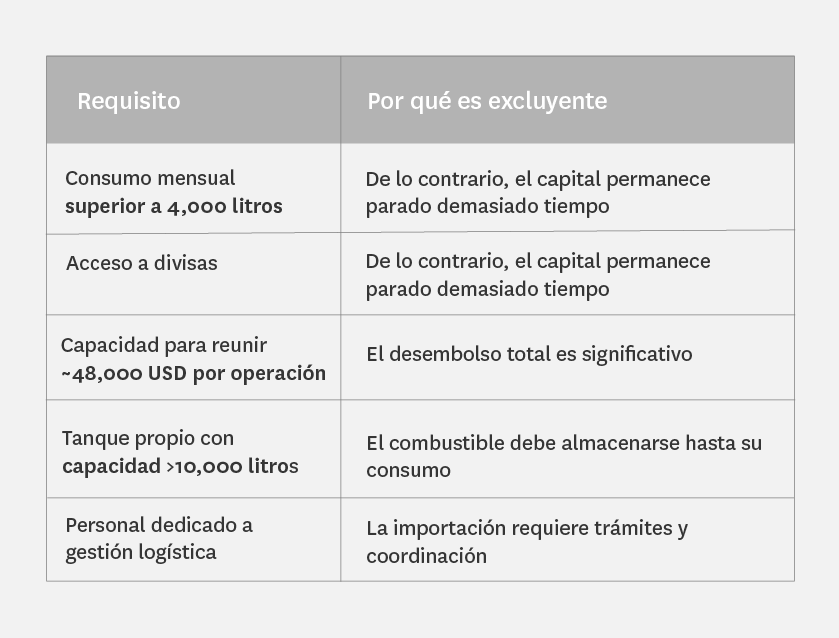
To import a 25,000-liter ISO tank, a company needs to meet several structural requirements:
What the cross-section with the sector matrix reveals
When we apply these filters, the result is conclusive:
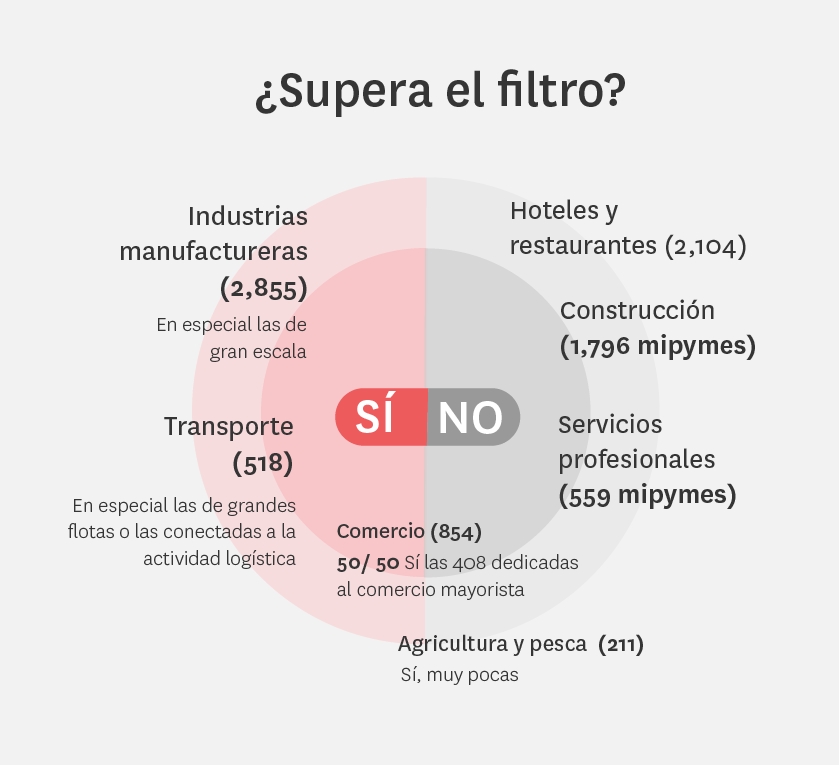
The only businesses that might be eligible are a fraction of large-scale manufacturing industries and transportation companies with established fleets. In both cases, these are businesses that were already operating at significant volumes before the crisis, have access to foreign currency, possess their own storage infrastructure, and have the management structure to handle complex operations.
The estimate yields a figure of less than 33% of all private companies registered in Cuba. The majority of micro, small, and medium-sized enterprises (MSMEs), due to their inherent structural characteristics, are excluded from the possibility of importing fuel on their own.
This is not a matter of will or individual management capacity. It is a matter of sectoral structure: the sectors that concentrate the largest number of MSMEs in Cuba—food service, commerce, construction, and services—simply do not fit the profile required for this operation.
Collective purchasing: the unexplored path
If individual importing is only viable for a minority, the question is inevitable: what about the other 6,000 businesses that cannot do it on their own?
The answer lies in a model that is common in other countries but barely exists in Cuba: collective purchasing.
The idea is simple in theory: a group of small business owners joins together, raises the necessary capital for an ISO tanker, imports the fuel, and distributes it among the members according to their consumption. Each member pays only the actual cost, without intermediary margins or a black market, and everyone has access to a price much lower than what they would have to pay individually.
In practice, the model offers clear advantages. Scale is built collectively: a company that consumes 1,500 liters per month cannot import alone, but together with ten others, it can. The cost per company is drastically reduced: while individual imports require raising approximately $48,000 USD in a single upfront investment, in a group of twelve companies, each would contribute around $4,000 USD. Access to foreign currency ceases to be an individual problem: it only requires one or two members to have the capacity to pay abroad. Storage can be rotated or shared, distributing fuel as each partner needs it. And the risk, instead of being concentrated on a single company, is distributed among all members of the group.
The potential is enormous. If this model were developed, the number of companies benefiting could increase from a few hundred to several thousand, with annual savings exceeding $70,000 USD per company.
The path to collective purchasing faces four barriers today, which explain why, a month after the announcement, there are almost no examples in Cuba.
The first is legal: there is no clear regulation allowing a group of companies to register a joint import.
The second is fiscal: if one of the companies is listed as the importer and then sells the fuel to the others, that constitutes a resale, which is not clearly regulated.
The third is logistical: shared storage infrastructure and coordination for distribution are needed.
And the fourth, perhaps the most difficult, is trust: pooling tens of thousands of dollars among several business owners requires solid contracts, clear guarantees, and absolute transparency in the management of funds.
That’s where specialized knowledge makes all the difference. At AUGE, we have years of experience advising Cuban private companies on regulatory navigation, business structuring, and connecting with reliable suppliers. We understand the mechanisms because we have seen them work, because we have accompanied clients at every step of the process, and because we know where the bottlenecks are, as well as the opportunities.
It’s not just about knowing the theory: it’s about having been in practice, having seen what works and what doesn’t, knowing what questions to ask and to whom.
That’s why, when we talk about collective purchasing, we don’t do so from a place of speculation. We do so from the conviction that it’s a viable path, but one that requires expert facilitation: knowledge to structure agreements, management of import procedures, shared logistical coordination, and transparency in costs and distribution.
It also requires the government to facilitate the process with clear regulations and for tax authorities to define the treatment of these transactions.
Until that happens, collective purchasing will remain a theoretical possibility, a path explored by very few. But for most Cuban micro, small, and medium-sized enterprises (MSMEs), it remains the only realistic way to access imported fuel.
It’s not a magic bullet or an immediate solution. It’s a path that requires organization, trust, and clear rules. But it exists. And the potential is too great to ignore.