


Trade between Cuba and the United States is undergoing a quiet transformation that belies the bilateral political stagnation. While the island's total imports are contracting, U.S. exports to Cuba continue to grow.
—
Despite the polarization, Havana and Miami have never been closer. While the political conflict between Havana and Washington remains mired in decades of confrontation, a parallel reality has emerged in the economic sphere. The Cuban private sector and businesses in Miami—especially those belonging to the Cuban-American community—are already deeply interconnected. Not through large bilateral agreements, but through remittances converted into capital, supply chains operating in the spaces between two legal systems, talent crossing the Florida Straits without leaving home, and digital platforms connecting supply and demand on both sides.
At AUGE, we have been observing and supporting this reality for years. Since 2015, we have worked with hundreds of Cuban entrepreneurs, and in 2022 we published our report, AUGE’s Top 100 MSMEs, where we documented, among other findings, that 16% of the MSMEs we helped establish during the first year of private business creation in Cuba had Cubans residing abroad, primarily in the United States, among their partners. The participation of the Cuban diaspora in the Cuban private sector is not new: it has at least four years of documented history, and the March 2026 reform that legalizes investment by Cuban-Americans formalizes a reality that already existed.
The numbers that tell the story
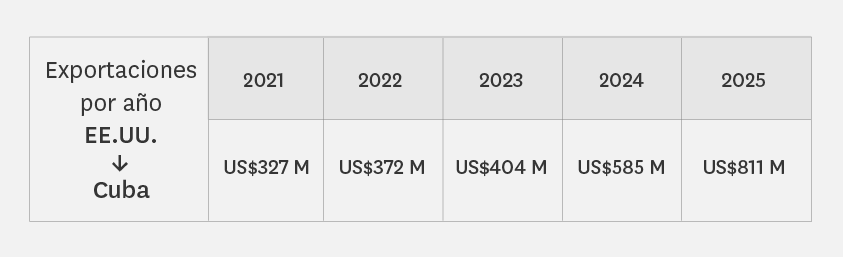
Between 2021 and 2025, U.S. exports to Cuba grew by 148%, from US$327 million to US$810.8 million. This growth did not occur by chance. It coincides directly with the expansion of the Cuban private sector, which requires supplies, equipment, and goods that domestic production cannot meet.
The most revealing finding: in 2025, exports specifically destined for the Cuban private sector (MSMEs) reached US$173.6 million. Vehicles alone, the most dynamic sector, accounted for US$149.4 million in exports, a 122% increase compared to the previous year.
While US exports grew, Cuba’s total imports contracted drastically. Between 2022 and 2025, the island’s purchases from abroad fell by 37%, affected by the currency crisis and the reduction in trade with traditional partners like Venezuela. In this context of general contraction, the United States’ share of Cuban imports has multiplied. It rose from 3.9% in 2021 to an estimated 13.1% in 2025. In other words, while the overall pie shrank, the US share grew significantly.
This discrepancy is not a statistical error. It is, in itself, the most compelling evidence of the invisible interconnection. US products reach Cuba through three channels that traditional trade statistics do not capture: re-exports via third countries (Panama, Mexico, Spain); donations and family remittances, which are not classified as commercial imports; and direct supply to the private sector, which operates through informal channels.
Analysis of the relationship between these two variables reveals a counterintuitive pattern: when Cuba’s total imports fall, US exports rise. Between 2021 and 2025, while Cuba’s total imports contracted by 37%, exports from the US grew by 148%. Bilateral trade has acted as a countercyclical channel, resilient to the currency crisis that has affected other suppliers. The most plausible explanation is the MSME effect: the Cuban private sector, largely financed by remittances from the US, has demanded specific products—vehicles, equipment, supplies—that the Cuban state does not import in significant quantities. This has created a parallel import channel that does not depend on public currency.
The invisible interconnection
Remittances from the United States are a vital fuel for the Cuban economy. They not only support household consumption but have also become a major driver of private sector investment. They function as seed capital for the creation of new MSMEs, as working capital financing for existing businesses, and as loans between family and friends that fuel entrepreneurial ventures. Furthermore, remittances boost the purchasing power of Cubans living on the island, who are increasingly acquiring their basic goods from the private sector—either through the retail network or via online platforms—generating a cycle that sustains the Cuban business ecosystem.
A key player in this ecosystem is the remittance and parcel delivery agencies operating in Florida and other parts of the United States. These companies, many founded by Cuban-Americans, have evolved significantly in recent years. What began as simple money and package delivery services using “mules” has transformed into complex logistics operations utilizing air and sea freight, offering an increasingly wide range of products. A preliminary study of their offerings is the best way to understand which products are in highest demand in Cuba. The most successful agencies have expanded to trade everything from food to batteries, generators, motorcycles, and electric bicycles, making them the quickest to respond to changes in demand on the island. Furthermore, many have set up systems for purchases on platforms like Amazon, Shein, and Temu with guaranteed deliveries to Cuba. These agencies have partnered with local micro, small, and medium-sized enterprises (MSMEs) or created their own companies on the island for last-mile delivery services, ensuring that products reach the final recipient without incident.
South Florida is the logistical epicenter of trade between the United States and Cuba. In 2023, Crowley Maritime, the only shipping company transporting goods to Cuba from the United States, revealed at a meeting with private business owners in Havana that they were sending more than 300 containers weekly to Mariel from three ports: Fort Lauderdale, North Carolina, and Jacksonville, both 20-foot and 40-foot containers.
This is no small detail. Behind each container is a chain that begins with a supplier in Miami or the southeastern United States, a consolidator that groups products from multiple exporters, a freight forwarder that manages the documentation under OFAC licenses, and a recipient in Cuba—increasingly, a micro, small, or medium-sized enterprise (MSME)—that distributes the products on the island.
This weekly volume gives an idea of the magnitude of the logistical flow that feeds the Cuban private sector. In 2023, total U.S. exports to Cuba reached US$404 million, a significant portion of which went to the Cuban private sector. If each container carries, on average, goods worth between US$30,000 and US$50,000 (depending on the type of product and consolidation), the more than 300 containers per week would represent a monthly flow of between US$3.6 and US$6 million, and an annual flow of between US$43 and US$72 million through this shipping line alone.
In the absence of official US chains, Cuban entrepreneurs have created private businesses inspired by iconic brands. Starcafé (inspired by Starbucks), Burger Queen (inspired by Burger King), and KFC-style establishments have emerged in Havana since 2023, demonstrating the latent demand for global brands and the capacity of Cuban entrepreneurs to adapt them.
But beyond these adaptations, there are US brands with a real presence in the Cuban market through import channels. Ecoflow (batteries and portable generators), Colgate (hygiene products), Ford, Dodge, and General Motors (vehicles and auto parts), Coca-Cola and Pepsi (beverages), Pilgrims Pride and Koch Foods (chicken), Kellogg’s (cereals and snacks), Goya (canned and processed foods), Café La Llave (coffee), and Hershey’s (confectionery) are just some of the companies whose products are regularly found in Cuban stores, restaurants, and homes, supplying both the private sector and family consumption.
The Marketing of Interconnection: How Miami Companies Are Breaking Into Cuba
To reach Cuban consumers—both on and off the island—Florida-based companies have deployed a sophisticated digital marketing strategy that few notice but is present in the daily lives of millions of Cubans. The most popular social media platforms among Cubans—Facebook, Instagram, and WhatsApp—have become the primary showcase for these companies.
It’s not just conventional advertising. Shipping agencies, food importers, vehicle and battery sellers, and delivery platforms have developed targeted campaigns, video content, customer testimonials, and, above all, a strategy that often goes unnoticed: hiring influencers who live in Cuba or abroad but were once well-known figures in the Cuban arts, television, or sports world.
An actor or actress who years ago starred in Cuban telenovelas, a musician with decades of experience, or a former high-performance athlete might now appear promoting a parcel delivery agency, a battery brand, or a shipping service from Miami. Their credibility, recognition, and deep roots in the Cuban community—both on and off the island—make them the perfect vehicle for conveying trust in a market where trust is the most valuable asset.
This strategy is not a minor detail. It reveals that the Cuban market is no longer approached with the informality of the past.
Companies targeting Cuba—from major brands to small shipping agencies—have professionalized their communication, understand their audience, and use modern marketing tools to connect with potential customers. This is another indicator, perhaps less visible than the shipping containers in Mariel, that the economic interconnection between Miami and Havana not only exists but is deepening and becoming more sophisticated.
What’s being exported: a look at the products arriving in Cuba
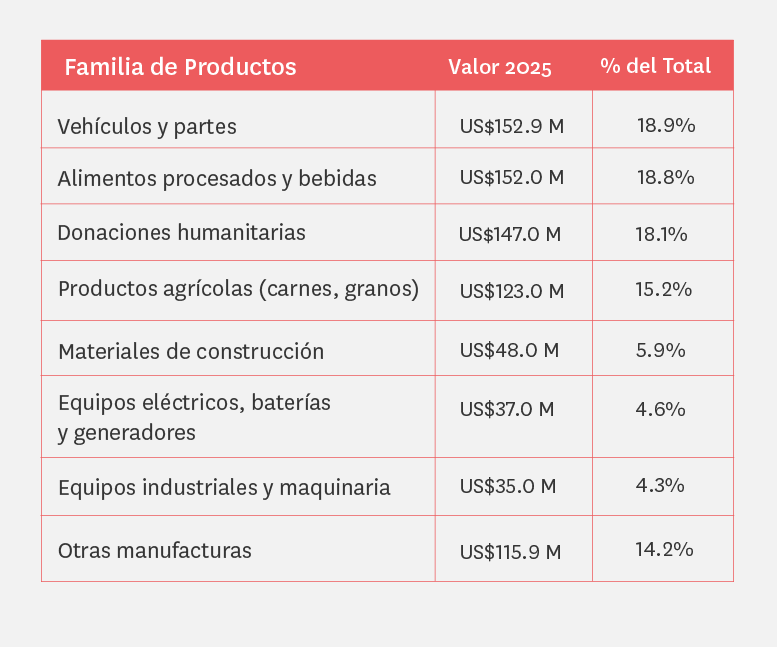
A detailed analysis of U.S. exports to Cuba in 2025 reveals which products are supplying the Cuban private sector. Of the $810.8 million exported, the main product categories are distributed as follows:
Source: Based on data from the US Census Bureau
The most revealing data point in this table is the weight of vehicles and parts (18.9%), along with processed foods and beverages (18.8%). Together, they represent more than a third of everything the U.S. exports to Cuba. This is no coincidence: they are precisely the two critical inputs needed by a growing private sector dedicated to transportation (taxis, delivery, freight) and commerce/food service (stores, restaurants, cafes, catering services).
Within agricultural products, chicken (US$65 million) and pork (US$45 million) account for 90% of this category, confirming that Cuba is critically dependent on imports of animal protein from the U.S. to supply both the state and private sectors. Companies like Pilgrims Pride and Koch Foods are key suppliers in this segment.
In processed foods and beverages, brands such as Coca-Cola, Pepsi, Kellogg’s, Goya, Café La Llave, and Hershey’s have a consolidated presence in the Cuban market, supplying both the retail network and the private food service sector.
Finally, electrical equipment, batteries, and generators (US$37 million) have emerged as a strategic category. The energy crisis affecting Cuba since 2014 has made these products critical inputs for the operation of Cuban MSMEs and households. Ecoflow, with its portable batteries and solar generators, has positioned itself as one of the most in-demand brands in this niche, along with other Cuban-American companies that have developed expertise in supplying energy solutions.
The New Framework: Diaspora Investment and Real Opportunities
The context described so far—an economic interconnection already functioning in practice—has been reinforced by a historic announcement from the Cuban government in March 2026. Deputy Prime Minister Oscar Pérez-Oliva Fraga confirmed that Cubans residing abroad will be able to invest directly in the island’s private sector, opening three concrete avenues: becoming a partner in a newly created micro, small, or medium-sized enterprise (MSME), joining an existing MSME as a partner, or participating in foreign investment schemes alongside Cuban private companies.
This change does not come in a vacuum. It arrives amidst the worst energy crisis Cuba has faced in decades, with blackouts paralyzing the economy. Opening the door to investment from Cuban-Americans is an acknowledgment that the country needs to mobilize all available resources to weather the storm. The diaspora has capital, international experience, networks, and, in many cases, the desire to contribute.
But the announcement, while historic, faces long-standing obstacles. The slow approval process for micro, small, and medium-sized enterprises (MSMEs), the banking and exchange rate chaos exacerbated by the energy crisis, the lack of confidence in the regulatory framework, and, above all, the weight of U.S. sanctions that disproportionately affect Cuban-Americans with U.S. citizenship. For this type of investor, any transaction must be scrutinized to avoid violating OFAC regulations.
Added to this is a fundamental practical challenge: how do those seeking investment connect with those offering capital? Currently, there is no transparent marketplace where supply and demand can meet. This is where AUGE has been playing a crucial role: bridging the gap with sound judgment, evaluating projects, structuring agreements, and building trust between Cuban and Cuban-American businesspeople interested in investing.
Six sectors where the connection is strongest
The Cuban-American presence in the Cuban economy is concentrated in specific sectors where local knowledge, family networks, and logistical capacity from Miami generate comparative advantages.
- Basic Consumption Products: Processed foods, cleaning products, and hygiene items—everyday goods—arrive through Miami-based companies that have developed specialized supply chains.
- Batteries and Equipment for the Energy Crisis: The electricity crisis affecting Cuba since 2014 has made Miami the main source of batteries, inverters, solar panels, and generators for families and micro, small, and medium-sized enterprises (MSMEs)
- Transportation: US$149 million worth of vehicles alone were exported to the Cuban private sector in 2025. Cuban-American companies manage the entire process: purchasing, BIS licenses, logistics, and delivery.
- Wholesale Trade: Miami-based companies have obtained authorization from the Cuban government to operate as commercial representatives on the island, formalizing a role that previously operated in a gray area.
- Retail: Through remittances and shipments of goods, Cuban-American families finance clothing, footwear, and appliance stores operated by their relatives in Cuba.
- Online commerce and technology platforms: Delivery apps, marketplaces, and payment platforms developed by Cuban-American entrepreneurs connect supply and demand on both sides of the Strait, with servers in the U.S., development talent in Cuba, and users in both countries.
Looking ahead
If current trends continue, U.S. exports to Cuba could reach $1.2–1.3 billion by 2028, solidifying the U.S. as one of the island’s main suppliers. An optimistic scenario, with relaxed OFAC licensing requirements and Cuban economic recovery, could raise that figure to $2 billion. A pessimistic scenario, with stricter sanctions or setbacks in Cuban reforms, could shrink bilateral trade to $400–500 million annually.
The factors to monitor are clear: the evolution of the regulatory framework in both countries, the implementation of diaspora investment in Cuba, the flow of remittances and the availability of foreign currency, and the bilateral political context. In particular, the impact of the new law will depend on how the structural obstacles—banking, regulatory, and trust-related—are resolved and how quickly the mechanisms for connecting investment supply and demand are activated.
A reality that demands recognition
The data and patterns described in this article point to a clear conclusion: the economic interconnection between Cuba and the United States through the private sector is already a consolidated reality. It operates beneath the political polarization, in the spaces that the regulatory frameworks of both countries allow—and sometimes, in the gray areas that necessity and creativity have created.
The relevant question is not whether this interconnection exists, but how to channel it in a way that generates stable opportunities for the actors involved: U.S. companies, Cuban entrepreneurs, and the business diaspora.